
Deloitte India on Friday said it estimates India's GDP growth at 6.6 per cent in the current fiscal helped by consumption expenditure, exports rebound and capital flows. In its India's economic outlook report, Deloitte said the rapid growth of the middle-income class has led to rising purchasing power and even created demand for premium luxury products and services. With the expectation that the number of middle-to-high-income segments will be one in two households by 2030/31, up from one in four currently, we believe this trend will likely become further amplified, driving overall private consumer expenditure growth, it said.

The IMF on Tuesday projected an impressive 12.5 per cent growth rate for India in 2021, stronger than that of China, the only major economy to have a positive growth rate last year during the COVID-19 pandemic. The Washington-based global financial institution, in its annual World Economic Outlook ahead of the annual Spring meeting with the World Bank, said the Indian economy is expected to grow by 6.9 per cent in 2022. Notably in 2020, India's economy contracted by a record eight per cent, the International Monetary Fund (IMF) said as it projected an impressive 12.5 per cent growth rate for the country in 2021.
The Reserve Bank of India on Friday revised upwards the GDP growth projection for the current fiscal to 7.2 per cent from 7 per cent on rising private consumption and revival of demand in rural areas. Unveiling the bi-monthly monetary policy, RBI Governor Shaktikanta Das said estimates released by the National Statistical Office (NSO) placed India's real gross domestic product (GDP) growth at 8.2 per cent in 2023-24. "During 2024-25 so far, domestic economic activity has maintained resilience," he said, adding that manufacturing activity continues to gain ground on the back of strengthening domestic demand.

The IMF said in its latest report that the global economy is likely to grow at a slower rate than previously forecast over the next two years.

The National Informatics Centre uses AI to automate document analysis and detect fraud in government departments.

Differing with International Monetary Fund's growth forecast of 4.9 per cent for India during 2012, Planning Commission Deputy Chairman Montek Singh Ahluwalia said it has a statistical problem.

The brokerage firm cautioned that there is a possibility of further downside risks to growth, especially in the near term as RBI's policy interest rate cuts in recent months has not been translated into reduction in bank lending rates.
It further said that as the trends in inflation have remained benign, it does expect any significant changes in monetary policy. The Reserve Bank of India also took monetary easing measures by infusing more than Rs 4,00,000 crore (Rs 4,000 billion) since October.

The International Monetary Fund (IMF) said on Thursday that a multilateral response is critical to overcome the COVID-19 pandemic in India and globally as it hailed recent announcements by several countries to provide immediate support to India. India is struggling with a second wave of the pandemic with more than 300,000 daily new coronavirus cases being reported in the past few days, and hospitals are reeling under a shortage of medical oxygen and beds.

From the Sensex pack, HCL Technologies, Infosys, Wipro, Bharti Airtel, Larsen & Toubro, Mahindra & Mahindra, Tata Consultancy Services and Asian Paints were the major gainers. Axis Bank, IndusInd Bank, Bajaj Finance, JSW Steel, State Bank of India and Tata Steel were among the major laggards.

Global trends, macroeconomic data, and the outcome of the US Fed policy meeting are the major factors that will drive the movement in the domestic equity markets this week, analysts said. "In the upcoming data-centric week, the focus will be on crucial releases, including inflation data from India and the US. "Indian inflation is expected to rise, while US inflation will remain steady.

India's economic growth prospects should remain strong over the medium term, with GDP expanding 6-7.1 per cent annually in fiscal years 2024-2026, S&P Global Ratings said on Thursday. In a report titled 'Global Banks Country-By-Country Outlook 2024', S&P said the banking sector's weak loans will decline to 3-3.5 per cent of gross advances by March 31, 2025, on the back of structural improvement, including healthy corporate balance sheets, tighter underwriting standards and improved risk-management practices. Interest rates in India are unlikely to rise materially, and this should limit the risk for the banking industry, it added.

It has also reduced its year-end target for the BSE benchmark Sensex by 15 per cent to 18,850.

'Our vision for the future includes the creation of an active ecosystem, human space flight, a human space station.'
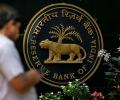
RBI said aggregate demand during the year so far suggests that the shock to consumption is severe, and it will take quite some time to mend and regain the pre-COVID-19 momentum.
With the Central Statistical Organisation estimates putting India's economic growth rate at 8.7 per cent for the current financial year, spotlight has turned on GDP forecasts by various other agencies.
The agency said announcements by Modi and Finance Minister Arun Jaitley after government formation 'signal a strong intention to pursue reforms'.

'China is struggling to get out of its property bubble.' 'Japan took 35 years to walk out of its equity bubble.' 'Bubbles can be difficult to forecast.'

The government's programmes should be expected to generate some momentum, but the macro-economic numbers are not encouraging, observes T N Ninan.

2016 will be the first time in 15 years that the ratio between trade growth and world GDP will fall below 1:1

Asian Development Bank on Tuesday raised India's growth forecast for the current fiscal to 8.5 per cent from 8.2 per cent but expressed concern over persistent high inflation and rising value of rupee which could undermine future economic expansion.

Prime Minister's key economic advisor C Rangarajan on Friday lowered the growth forecast for the current fiscal to 5.3 per cent from 6.4 per cent projected earlier and listed out host of measures including further liberalisation of foreign direct investment norms to improve economic condition.

IndusInd Bank was the top loser in the Sensex pack, shedding around 3 per cent, followed by Dr Reddy's, NTPC, Maruti, Axis Bank, Bajaj Auto, Bharti Airtel and HDFC. NSE Nifty declined 76.15 points to 15,691.40.

The Centre for Monitoring Indian Economy (CMIE) has lowered its automobile production forecast by a percentage point to 9.6 per cent for this fiscal on account of a persistent higher interest rate regime, hike in taxes and the resultant increase in vehicle prices.

'The nominal GDP growth assumption for FY25 may be revised upwards on higher growth expectations.'
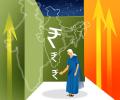
Structural reforms, pro-people programmes and employment opportunities helped the economy get new vigour, the finance minister said. After contracting by 5.8 per cent in 2020-21, the economy recorded a growth of 9.1 per cent in 2021-22.
The OECD, in March, projected 4.3 per cent economic expansion for India in 2009. The report further said the extent of the deterioration in the fiscal position prior to the slowdown has reduced the scope for 'discretionary fiscal policy action'.

Very often, 'sentiment' drives prices well beyond what is warranted and it is hard to forecast market sentiment, explains Debashis Basu.
The XLRI School of Management, Jamshedpur, has revised its set of courses in Economics for its Business Management students.

IMF cut its 2016 global growth forecast for the fourth time in the past year to 3.2 per cent, citing China's slowdown.

'With India's growing capabilities in the space sector, this creates promising opportunities for enhanced collaboration and market access.'

The arrival of the June-September rains has been delayed.

From the Sensex basket, JSW Steel, Tata Steel, UltraTech Cement, NTPC, Larsen & Toubro and HDFC Bank were the major gainers. Titan, Nestle, Bharti Airtel and IndusInd Bank were among the laggards.

In an address from the lectern on the steps of 10 Downing Street on a rainy London evening, Britain's first Prime Minister of Indian heritage confirmed a summer poll in six weeks' time and that the Parliament would soon be dissolved after he formally informed King Charles III of the election timeline.

If this turns into reality, India's gross domestic product (GDP) growth will be the lowest since 2012-13, which could severely hit job creation and income growth in the near term.

S&P Global Ratings on Monday retained India's GDP growth forecast at 6 per cent saying it will be the fastest growing economy among Asia Pacific nations. The GDP growth forecast for the current and the next fiscal has been kept unchanged from the forecast made in March partly on account of domestic resilience. "We see the fastest growth at about 6 per cent in India, Vietnam, and the Philippines, S&P Global Ratings said in its quarterly economic update for Asia-Pacific.
The wholesale price index inflation is projected at 6.4 per cent for 2017-18.
Global rating agency Fitch has revised upwards India's growth projection to 6 from 5 per cent for the current fiscal and said the recent election results should provide additional confidence and spur growth.

Credit rating agency Crisil observed in its report that some 'high frequency indicators go out of whack' as credit growth and service tax collections are not in tune with the CSO's growth projections.

'This encourages escapism through the politics and economics of nationalism, made worse by tribalism or nativism, the package accompanied inevitably by the erosion of institutional bulwarks and therefore State capture by powerful businessmen,' notes T N Ninan.
